
THE ARMOR OF GOD: A REALISTIC VISUAL GUIDE
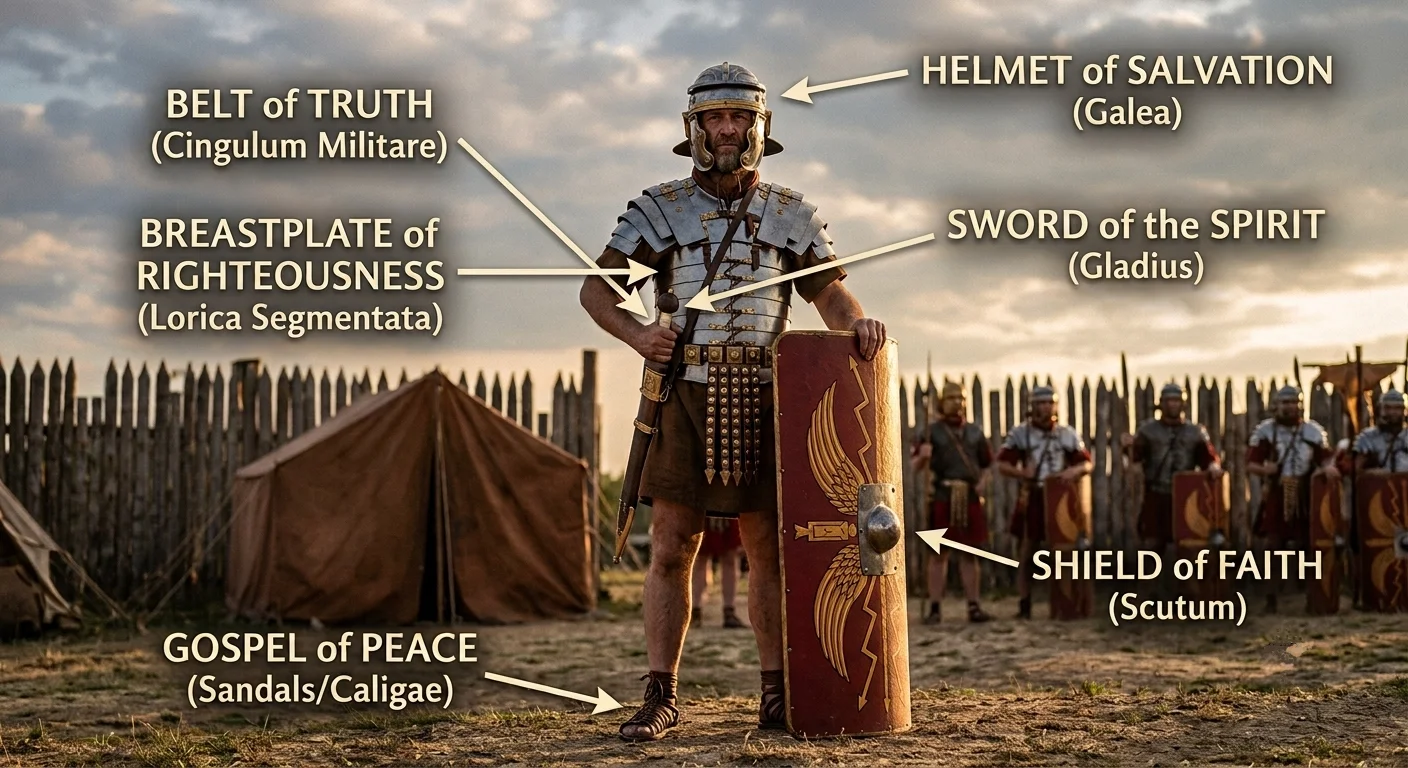
Historically accurate and realistic image of a Roman soldier and his armor with all the Ephesians 6 elements called out
You have likely seen the Sunday school posters: a cartoonish knight in shiny blue armor, carrying an oversized sword with sparkling edges and a clipart shield with a cross slapped on it.
Here is the problem: Paul was not talking about medieval fantasy armor.
When the Apostle Paul wrote Ephesians 6:10-18, he was sitting in a Roman prison, guarded by Roman soldiers wearing actual, battle-tested equipment. He was not imagining fairy tale warriors. He was describing the gritty, heavy, and highly functional gear that kept soldiers alive in the ancient world.
To truly understand the armor of God meaning, we need to see it the way Paul's original audience did: realistic, functional, and absolutely essential for survival.
Understanding the Historical Context of the Armor of God
Paul's readers in Ephesus did not need an explanation of what a breastplate or helmet looked like. They saw Roman soldiers on duty every single day. The Roman Empire dominated the Mediterranean world through superior military tactics and highly engineered equipment. Their armor was not decorative; it was built for combat.
Each piece served a specific, life-or-death purpose:
The belt held everything together and allowed freedom of movement.
The breastplate protected vital organs from lethal sword strikes.
Sandals with metal studs provided stability on treacherous terrain.
The shield was large enough to cover the soldier's entire body.
The helmet deflected heavy blows that would otherwise crack the skull.
The short sword (gladius) was designed for rapid, close-quarters combat.
When Paul compared spiritual protection to Roman military gear, he was using the most powerful visual imagery available. This was not abstract theology; it was visceral, concrete, and urgent.
The Meaning of the Belt of Truth in the Armor of God
'Stand firm then, with the belt of truth buckled around your waist.' (Ephesians 6:14)
In realistic depictions of the armor of God, the belt is not a thin decorative strap. It is a wide, sturdy leather girdle, often reinforced with metal plates, that cinches the tunic and holds the entire uniform in place.
Roman soldiers could not fight effectively with loose fabric tangling their legs. The belt transformed a flowing tunic into a functional combat uniform, securing their weapons and providing core support.
The spiritual parallel is profound:
Truth is what holds your faith together when chaos tries to unravel it.
Without truth anchoring you, every other piece of armor becomes loose and ineffective.
Just as a soldier could not run into battle with an unbuckled belt, you cannot stand against deception without grounding yourself in God's objective truth.
The Breastplate of Righteousness Meaning: Guarding What Matters Most
'...with the breastplate of righteousness in place.' (Ephesians 6:14)
The Roman lorica (breastplate) was constructed from layered metal scales, interlocking chainmail, or segmented iron plates. It was heavy, hot, and restricted movement. Yet, soldiers wore it without complaint because it protected the heart, lungs, and other vital organs.
When looking at the armor of God in historically accurate art, you see bronze or iron catching the golden-hour light, marked by scratches and dents from previous battles. The weight is evident in how the soldier stands.
The spiritual application cuts deep:
Righteousness protects your heart from the accusations and doubts that seek to destroy you.
Living right with God is not about rigid legalism; it is about spiritual survival.
When condemnation strikes, Christ's righteousness deflects the blow.
Feet Fitted with Readiness: The Gospel of Peace in the Armor of God
'...and with your feet fitted with the readiness that comes from the gospel of peace.' (Ephesians 6:15)
Roman military sandals (caligae) looked nothing like modern, flimsy footwear. They were thick-soled leather boots with metal hobnails driven through the soles. These hobnails functioned like modern cleats, providing traction on muddy fields, steep hillsides, and blood-slicked battlegrounds.
A realistic visual would show sturdy leather straps wrapped tightly up the calf, heavy soles caked with dust from long marches, and metal studs worn smooth from miles of walking. The gospel of peace does not imply passivity. It means being ready to stand firm, advance when commanded, and remain stable when the ground beneath you starts to slip.
The Shield of Faith Meaning: Your Mobile Defense
'In addition to all this, take up the shield of faith, with which you can extinguish all the flaming arrows of the evil one.' (Ephesians 6:16)
The Roman scutum was massive, roughly four feet tall and two feet wide. Made of layered wood, wrapped in canvas and leather, and reinforced with a metal boss in the center, it was a mobile wall. In realistic depictions, you would see scorched leather from extinguished fire arrows and splintered wood where heavy projectiles struck.
Roman soldiers would often lock their shields together to form an impenetrable barrier called the testudo (tortoise) formation. Your faith is not meant to stand alone; it is strengthened when linked with the faith of other believers. The flaming arrows Paul mentions were real, terrifying weapons of the ancient world, designed to spread panic and fire. Your active shield of faith extinguishes these attacks before they can consume you.
The Meaning of the Helmet of Salvation in the Armor of God
'Take the helmet of salvation...' (Ephesians 6:17)
Roman helmets were masterpieces of ancient engineering. Crafted from bronze or iron, they featured cheek guards, a neck protector, and a reinforced brow ridge. This design protected against downward sword strikes, heavy projectiles, and blunt force trauma. Because head wounds were almost always catastrophic, the helmet was non-negotiable.
The spiritual imagery is powerful: salvation protects your mind and thoughts from the crushing blows of doubt and despair. The absolute assurance of your salvation keeps you thinking clearly in the heat of battle. Without it, a single well-placed lie can be fatal.
The Sword of the Spirit: The Offensive Weapon of the Armor of God
'...and the sword of the Spirit, which is the word of God.' (Ephesians 6:17)
The Roman gladius was a short sword, about 18 to 24 inches long. It was not designed for elegant, sweeping slashes, but for brutal, efficient thrusting in close-quarters combat. This is the only offensive weapon mentioned in Paul's description of the armor of God.
A realistic portrayal shows a worn leather grip shaped by years of use, and a blade kept sharp enough to split hairs. The Word of God is not decorative; it is not meant to hang passively on a wall. It is meant to be held firmly, understood deeply, and wielded with precise accuracy.
Why Realistic Visuals of the Armor of God Matter
Paul chose military imagery because it was concrete and immediate. His readers could close their eyes and picture every single detail. When we replace that gritty realism with cartoon clipart, we risk losing the urgency of his message. We domesticate something that was meant to be intense, protective, and life-saving.
Realistic visuals of the armor of God restore this power by:
Reminding us that spiritual warfare is real, not a lighthearted game.
Connecting ancient biblical truths to tangible historical reality.
Helping us visualize what we are actually putting on each day.
Standing Firm with the Armor of God
Putting on the armor of God is not a one-time symbolic act; it is a daily habit of preparation for real spiritual challenges. Paul concludes Ephesians 6 by emphasizing prayer: praying 'on all occasions with all kinds of prayers and requests' (Ephesians 6:18). The armor equips you for the stand, but prayer keeps you connected to your Commander.
If you want to surround yourself with these powerful visual reminders, explore our collection of Christian wall art featuring cinematic, realistic biblical scenes. These pieces are designed for adults who want their home decor to reflect a faith that is as strong, resilient, and powerful as it truly is.
The battle is real, the armor is real, and the God who equips you is greater than any force that stands against you.
