
USING MODERN CGI AND VIRTUAL PRODUCTION FOR BIBLICAL EPICS
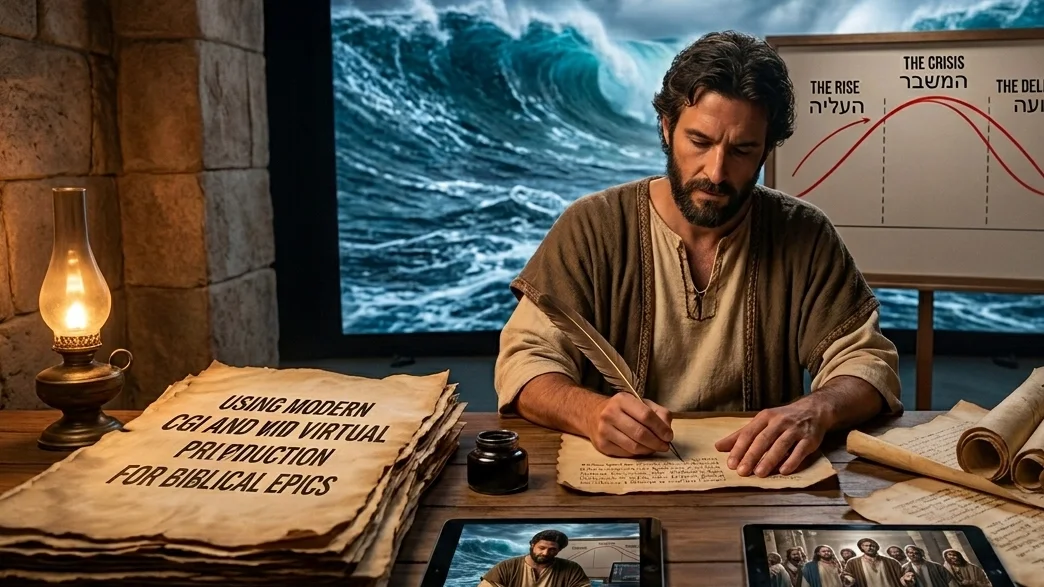
Creating biblical epics with modern CGI
The Desktop Epic: How Pure Digital Animation is Resurrecting the Ancient World
For decades, the brutal realities of the physical world dictated the limits of historical filmmaking. Capturing a sweeping epic meant mobilizing hundreds of crew members into remote deserts, enduring unpredictable weather, and waiting hours just to catch ten fleeting minutes of perfect golden light.
Today, that frantic race against the sun is over. The dusty, logistically punishing realities of traditional film production are giving way to digital virtual environments and real-time engines like Unreal Engine 5.
By shifting to 100% digital cinematography, we have broken free from the physical constraints of nature and the staggering costs of traditional filmmaking. The ancient world is no longer bound by Hollywood budgets; it is being rebuilt brick by brick, entirely by hand.
Rebuilding History with Pure Data
Reconstructing antiquity requires a deep obsession with archaeological and historical accuracy. In the past, matching that standard meant building massive plaster sets or relying on sterile, flat green screens that required years of post-production guesswork.
Now, the combination of high-fidelity photogrammetry and real-time rendering changes everything. By analyzing historical records, ancient texts, and architectural surveys, digital artists can recreate long-lost environments with absolute precision.
Through photogrammetry, real-world textures, the coarse grain of ancient limestone, the exact mineral makeup of weathered mortar, and the rugged terrain of the Near East are captured via high-resolution imagery and converted into 3D assets.
When loaded into Unreal Engine 5, these assets utilize Nanite geometry to process billions of polygons simultaneously without a stutter. Every crack in a palace wall and every detail of an ancient marketplace can be rendered smoothly at 24 frames per second. The result isn't a glossy, idealized Hollywood backdrop; it is a raw, gritty, and visceral reality.
Populating the Past: Digital Character Craft
In a pure 3D workflow, world-building is only half the battle. Bringing the ancient world to life requires humanizing it.
Without casting directors, wardrobe departments, or physical actors, the responsibility shifts entirely to digital artistry. Using advanced character creation tools like Character Creator 5, we can design hyper-realistic historical figures from the ground up. This process goes far beyond simple modeling; it requires shaping the physical tolls of the ancient world onto the characters themselves, the weathering of skin from the harsh desert sun, the specific drape of early textiles, and the weight of period-accurate armor.
When these characters are integrated into Unreal Engine, the virtual camera allows for total creative control. A director can block a scene, manipulate focal lengths, and adjust complex camera movements through a virtual lens.
More importantly, the lighting is entirely dynamic. If a scene demands the sharp, contrasting shadows of a sun-bleached plaza to mirror a character's inner turmoil, it can be dialed in instantly. If a sequence requires a permanent, perfect golden hour, the digital sun stays exactly where it needs to be for as many takes as the story requires.
The Financial and Creative Freedom of the Virtual Studio
The financial barrier to entry for traditional historical dramas is notoriously high, often killing ambitious projects before they even start. Moving a massive crew to an international location costs hundreds of thousands of dollars a day. A single sudden sandstorm can freeze production and burn through a budget.
A pure digital pipeline removes these logistical risks entirely. The "location" is brought directly to the workstation.
An independent creator can shoot a quiet sunrise in an ancient palace courtyard at nine in the morning, a bustling city gate at noon, and a dramatic sunset across a rocky ridge at three in the afternoon, all from a single desktop. This absolute control allows a creator to execute dozens of complex cinematic setups across multiple digital landscapes in a single week. The production timeline shrinks, overhead drops to a fraction of traditional costs, and the focus returns entirely to the craft of storytelling.
The Democratization of the Epic
This technological shift is more than just a matter of budget or efficiency; it represents a profound democratization of historical and narrative storytelling.
For years, independent creators with a deep passion for history were locked out of the epic genre by the sheer gatekeeping of studio finance. By mastering real-time rendering and digital character design, the walls of budget, safety, and travel vanish.
The lasting power of historical narratives relies on how well we can make the ancient search for meaning feel alive today. By honoring the gritty, material reality of the past through modern digital craftsmanship, independent filmmakers can now create lasting, cinematic art that rivals the scale of major studios, proving that the true spirit of history lives in the vision of the creator, not the size of the production crew.
